
Body Mass Index (BMI)
.png)
What is body mass index (BMI)?
Body mass index (BMI) is a medical screening tool that measures the ratio of your height to your weight to estimate the amount of body fat. Healthcare providers calculate BMI by using weight in kilograms (kg) divided by the square of height in meters (m2).
In most people, BMI relates to body fat — the higher the number, the more body fat you may have — but it’s not accurate in some cases. BMI alone does not diagnose health. Healthcare providers use BMI and other tools and tests to assess someone’s health status and risks.
High body fat may lead to heart disease, stroke and Type 2 diabetes. Low body fat may be related to malnutrition. Just the right amount of body fat helps vitamins and minerals get into your body. It also provides a source of energy for your body, helps maintain body temperature and protects your organs.
You should not use the standard BMI chart to evaluate a child’s or teenager’s weight. Talk to your child's healthcare provider about the optimum weight range for their age and height.
What is BMI used for?
Healthcare providers use BMI to help diagnose weight types and as a screening tool for certain health conditions.
Diagnosing weight types with BMI
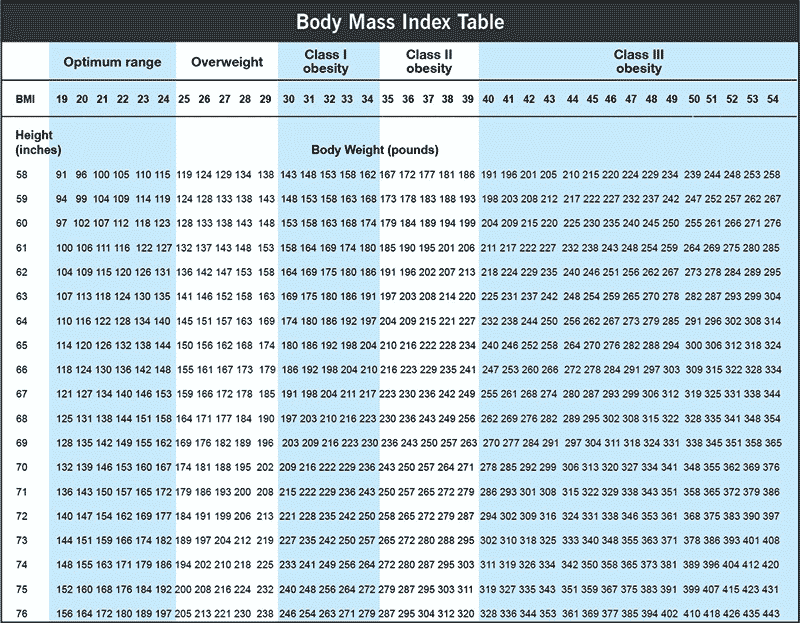
In general, the following BMI ranges (in kg/m2) classify different weight types:
- Underweight: Less than 18.5.
- Optimum range: 18.5 to 24.9.
- Overweight: 25 to 29.9.
- Class I obesity: 30 to 34.9.
- Class II obesity: 35 to 39.9.
- Class III obesity: More than 40.
BMI isn’t the only tool providers use to classify weight types. Other tools include:
- Measuring waist circumference.
- Measuring skin thickness using skinfold calipers in certain areas of your body, such as the back of your upper arms and under your shoulder blades.
- DEXA scan and air displacement plethysmography (ADP) — these are used less often.
How do I calculate my BMI?

You can calculate BMI yourself with these steps:
- Multiply your weight in pounds by 703.
- Divide that answer by your height in inches (there are 12 inches in 1 foot).
- Divide that answer by your height in inches again.
For example, a person who weighs 180 lbs. and is 5 feet and 5 inches tall (65 inches total) would calculate their BMI in the following way:
- 180 x 703 = 126,540.
- 126,540 / 65 = 1,946.769.
- 1,946.769 / 65 = 29.95.
Their BMI would be 29.9.
What is a healthy BMI?
The optimum range for a healthy BMI is considered to be 18.5 to 24.9.
It’s important to remember that body fatness isn’t the only determiner of overall health. Several other factors, such as genetics, activity level, smoking cigarettes or using tobacco, drinking alcohol and mental health conditions all affect your overall health and your likelihood of developing certain medical conditions.
What are the limitations of BMI?
The standard BMI chart has limitations for various reasons. Because of this, it’s important to not put too much emphasis on your BMI.
Even though the BMI chart can be inaccurate for certain people, healthcare providers still use it because it’s the quickest tool for assessing a person’s estimated body fat amount.
Limitations of using BMI to help diagnose weight types
The standard BMI has limitations in regards to diagnosing weight types, including:
- BMI doesn’t differentiate between lean body mass (the weight of everything in your body except fat) and fat mass. Because of this, a person can have a high BMI (by being muscular) but still have a very low fat mass and vice versa.
- The same BMI chart is used for adults assigned male at birth (AMAB) and adults assigned female at birth (AFAB) even though adults AFAB typically have more body fat than adults AMAB.
- The BMI chart hasn’t been adjusted for the increasing average adult height over the years.
.png&description=Body Mass Index {BMI} : Known Yours.)
0 Comments